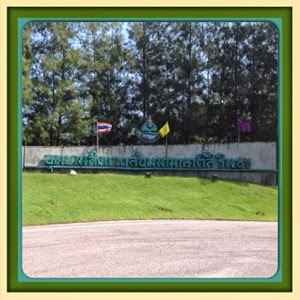
Remember my blog post about a "lost" palace?http://exercisingmywritesbyespiecorpuz.blogspot.com/2014/11/getting-lost-in-sirindhorn-park.html
Hubby and I returned to Sirindhorn Park in Cha-am to bike around. It was breezy but the afternoon was warm. After one round I decided biking wasn't really for me as I panic and lose my balance each time another biker gets too close. Hubby couldn't get me to bike one more round so we parked our rented bikes beside an arch covered with vines.
 |
| Just at the entrance, after walking past the souvenir shop and through an archway guarded by a couple of naked bronze statues, one on each side. |
 |
| Be welcomed by this sight as you pass through the vine-covered arched entrance. Be enveloped by the feeling of serenity and oneness with nature. The sound of the sea. Tje rustling of the leaves. The chirping of the birds and other insects. The sounds of silence. |
We enter the archway and find ourselves at the entrance of an expansive grassy grounds shadowed by giant acacia and ficus trees. The ficus trees look ominous with their intrinsically-gnarled roots that tell of age. Following the paved walkway a quaint structure looms in front of us. It is made of several individual wooden cottages on wooden stilts or legs and are interconnected by roofed path walks made of wooden planks. These cottages comprise the Palace and yes, we are on the Palace grounds!
 |
| This is it! The Mrigadayavan Palace. Simple and dainty, but once held the strongest power of the nation. The King lived here with his family and staff during summertime. The Palace consists of three big cottages or pavilions that looked exactly the same, connected by covered walkways that allow one a full view of the sea. |
 |
| From the entrance to the grounds, the Palace peeps through the trunks of a mixture of young and very old trees. Don't expect a sparkling structure. Made of teak wood and standing on hundred stilts, this one's different from all other palaces I've ever seen and imagined. |
 |
| Old trees with trunks covered with prayer envelopes. The whole area is sheltered with tall, verdant trees, making the otherwise humid day a fine day to stroll on the grounds. |
Excitedly, we looked for the entrance to the Palace, which proved quite a challenge because we couldn't read the printed signs. Some local guests helped us by pointing to the right cottage. What we thought to be the entrance was actually the exit!
So at the right cottage, we take off our shoes and leave our cameras behind. Barefoot, we climb the stairs and saunter somberly, as there are signs that request guests to keep silent in respect for locals who are there to meditate. Not all cottages are open for viewing, but then I have the feeling that these closed areas are not any different from the ones we have already seen.
Peeping into each one-room affair living quarter with divisions for private activities, one wonders how the occupants spent their time here, growing up and growing old. This palace had been home to the royal family and King Rama VI's concubines. One pavilion was for the exclusive use of the king; a second exclusive for the king's wife, Queen Indrasakdi Sachi, and her court; and a third, for multi-purpose functions.
These days this palace functions as a museum to showcase the life of the old royal family. Some of the displays include a wedding gown, beds, bathrooms, tea sets, musical instruments, etc. The focal point of this expansive museum was the huge dining hall that used to house a hundred diners--royal families, extended relatives, the concubines, foreign dignitaries, guests and probably the consorts. An antiquated menu for dinner is on display by the doorway and surprisingly, the whole course from appetizer to dessert was of French cuisine prepared by, of course, a French chef.
The whole structure is old and is undergoing preservation efforts initiated by King Bhumibol, Some areas at this time are cordoned to ward off guests because of on-going reconstruction activities.
 |
| The living quarters are elevated from the ground on hundreds and hundreds of pillars. |
 |
| The covered walk that goes all around one building and leads to the two other buildings. |
 |
| The whole structure is well-ventilated and the clean air coming from the ocean goes through open-wide windows, high ceilings and fretwork adorning the the walls. |
The architecture of the whole expanse of building is very appropriate to a life by the sea. The whole place welcomes the sea breeze to pass through and ventilate the quarters. The walls washed with white and pastel blue or pink do not clash at all with the natural green of the surroundings. I could imagine an evening stroll along the bridge to be so romantic, or an early morning walk at the Cha-am beach with the view of the Gulf of Thailand spread across the horizon, meeting up with the clear blue sky.
The tour thus ended, we reclaim our belongings and trace our way out of the Palace grounds, back to the beautiful entrance. Along the way we find a flowing fountain area concealed behind thick vines. This is a lovers' garden, definitely. I could almost visualize a youthful king professing his amorous intentions to a young queen or any of his concubines as they sit in one of those whitewashed benches in front of the fountain. No wonder this palace is called the Palace of Love and Hope.
 |
| Before one gets to the palace, or leaves the palace as is in our case, one passes by this rotund park ensconced within a wire fence covered with vines. At the center is a flowing fountain that gives the spot an impression of romantic dalliances at any time of day. |
My pride may have been wounded by my failure at my attempts to like biking, but the tour around the Palace-now-found healed the broken spirits completely. :-)